Cykel AI.

Cykel AI is redefining how businesses leverage AI by creating autonomous agents that proactively assist users, helping automate their complex day-to-day tasks in the background.

The goal was to define the strategy, platform and roadmap, shifting Cykel AI from a traditional SaaS model to simple, agent led experiences.

Product Lead
Product Design
Product Roadmap
User Experience
Prompt Engineering

Overview

Leading product design across Cykel AI from 0 to 1, I’ve shaped the design strategy and the product foundations, working closely with engineering and sales to define the roadmap and iterate the user experience based on real user feedback. This has involved navigating core adoption challenges, responding quickly to feedback, and turning those constraints into clearer, more confident product experiences.

Concept

The development of Cykel AI began with a vision to simplify complex, repetitive tasks by integrating AI agents into existing workflows. The product challenge was not adding an AI feature, it was creating an experience that feels trustworthy, predictable, and easy to adopt, even for users unfamiliar with how the system works behind the scenes.
The first agent, Lucy, focused on screening inbound CVs, surfacing strong matches, and proactively sourcing prospects to keep a healthy candidate pipeline. Behind the scenes, Lucy relied on complex models, data ingestion and multiple integrations. The design challenge was to present that capability as a focused experience that recruiters could trust and adopt without needing to understand the internal mechanics.
The interface highlighted clear matches, rankings and suggested actions, reducing configuration and pushing users towards confident next steps. This pattern of hiding technical sophistication behind simple, purposeful user flows became the foundation for later agents and for the wider platform direction.

Eve & GTM AI

As the platform developed, attention turned to Cykel’s sales agent, Eve. To get an MVP into users hands quickly, existing infrastructure and interaction patterns from Lucy were reused where possible allowing the team to ship the product as fast as possible without over engineering.
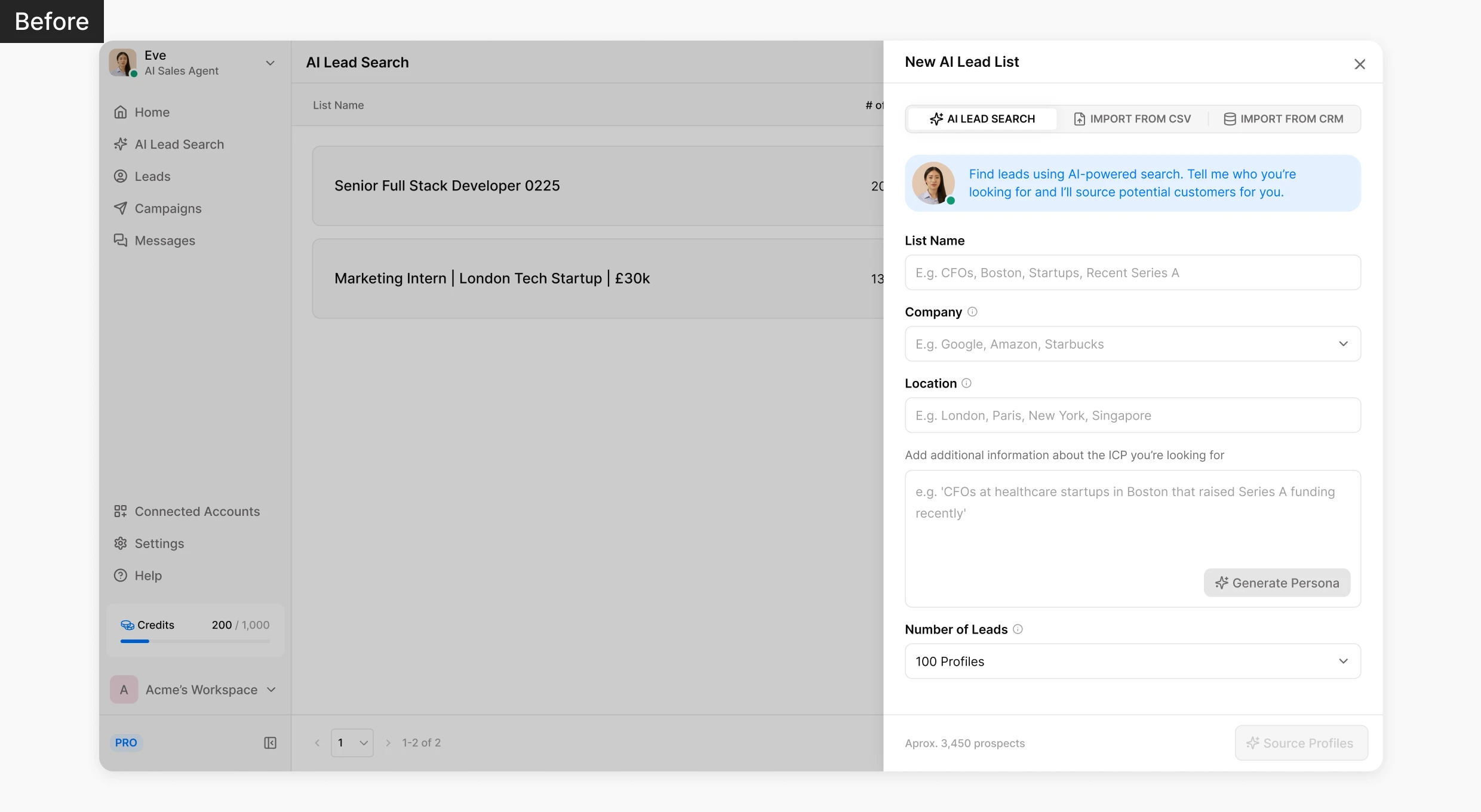
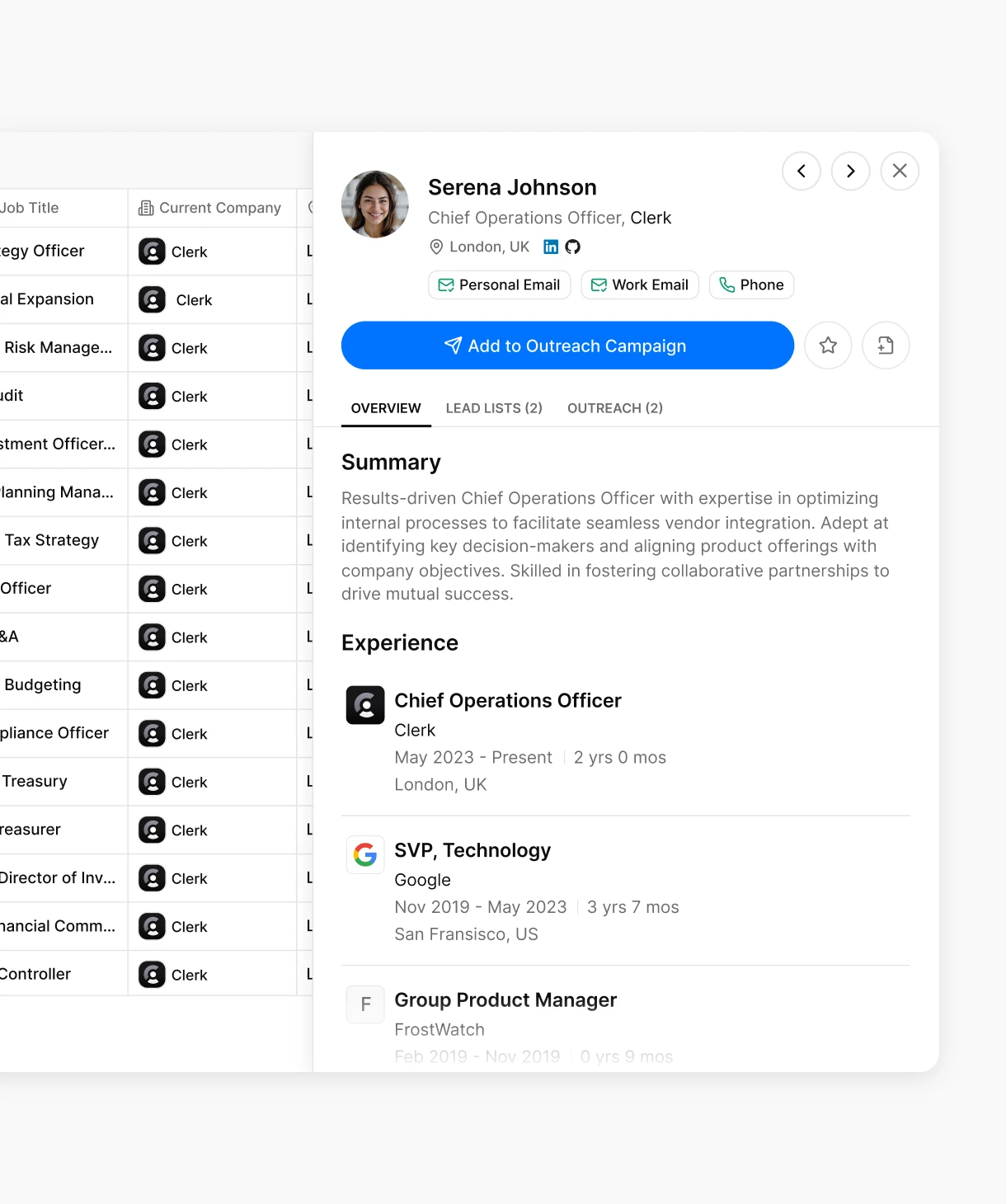
However, as soon as test groups started using Eve in real workflows, it became clear the way sales teams and recruiters build pipeline varied dramatically. The original lead search flow followed a familiar pattern. Users were asked to define Job Titles they wanted to reach, choosing filters such as Company, Location or industry, then scrolling through lead lists.
It quickly became clear this was the biggest adoption hurdle, as the workflow forced too much effort upfront. Test users consistently reported that results felt generic and required too much human-in-the-loop review, with leads still needing to be checked, company context needing to be verified, and leads still needed to be manually moved into outreach campaigns. The experience was positioned as automated, but the reality felt like extra work.
The core problem was not only lead quality and confidence but also cognitive load. Users we're still required to spend time validating the companies these leads worked for.

The Pivot

The direction changed based on direct customer feedback from these pilots along with research into what sales teams look for in an Ideal Customer Profile (ICP). This lead to the decision that a better starting point was the company itself.
The journey was redesigned around the users company URL. This leveraged a new feature, GTM AI, shifting effort away from users and onto the agent.

The solution

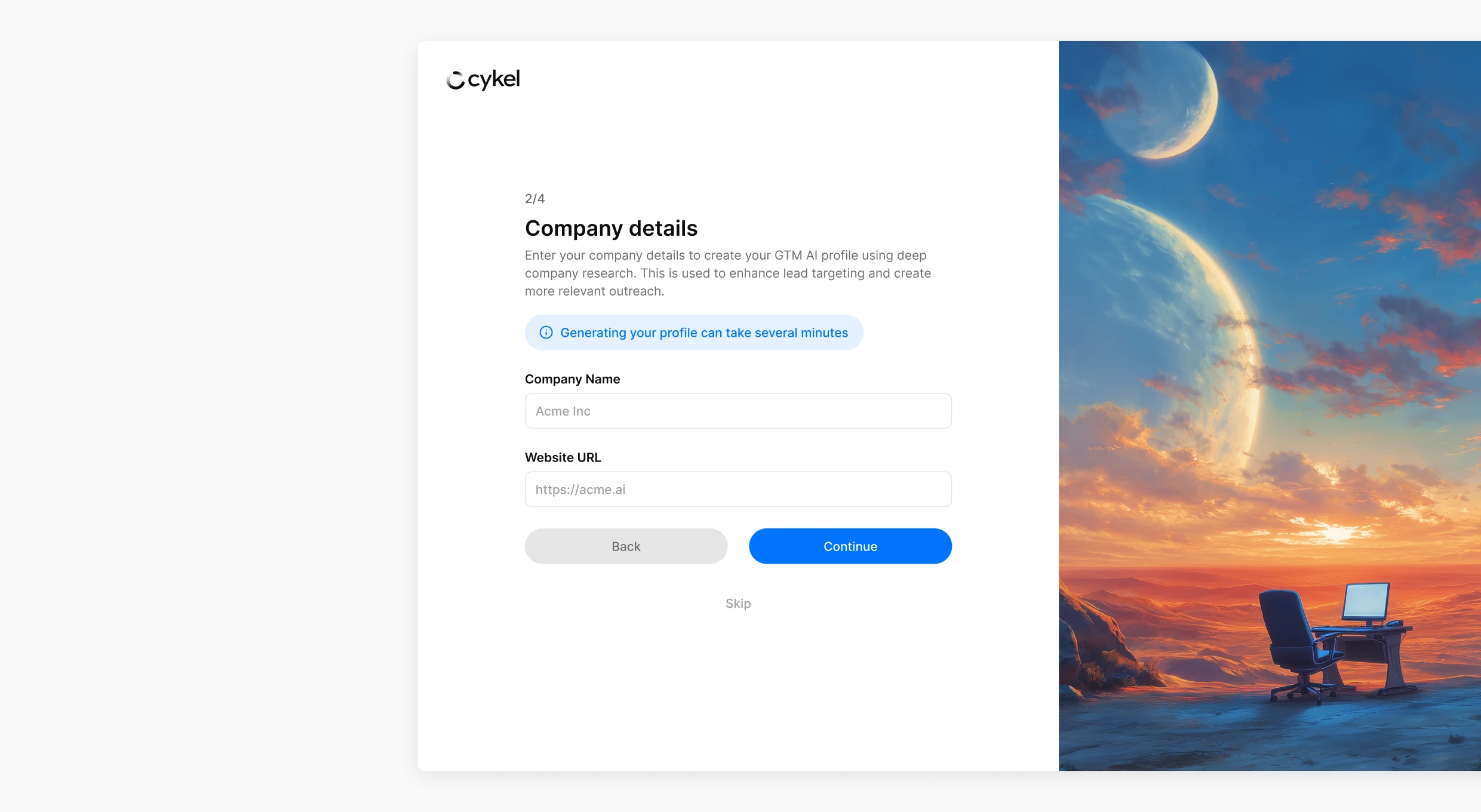
Company first onboarding
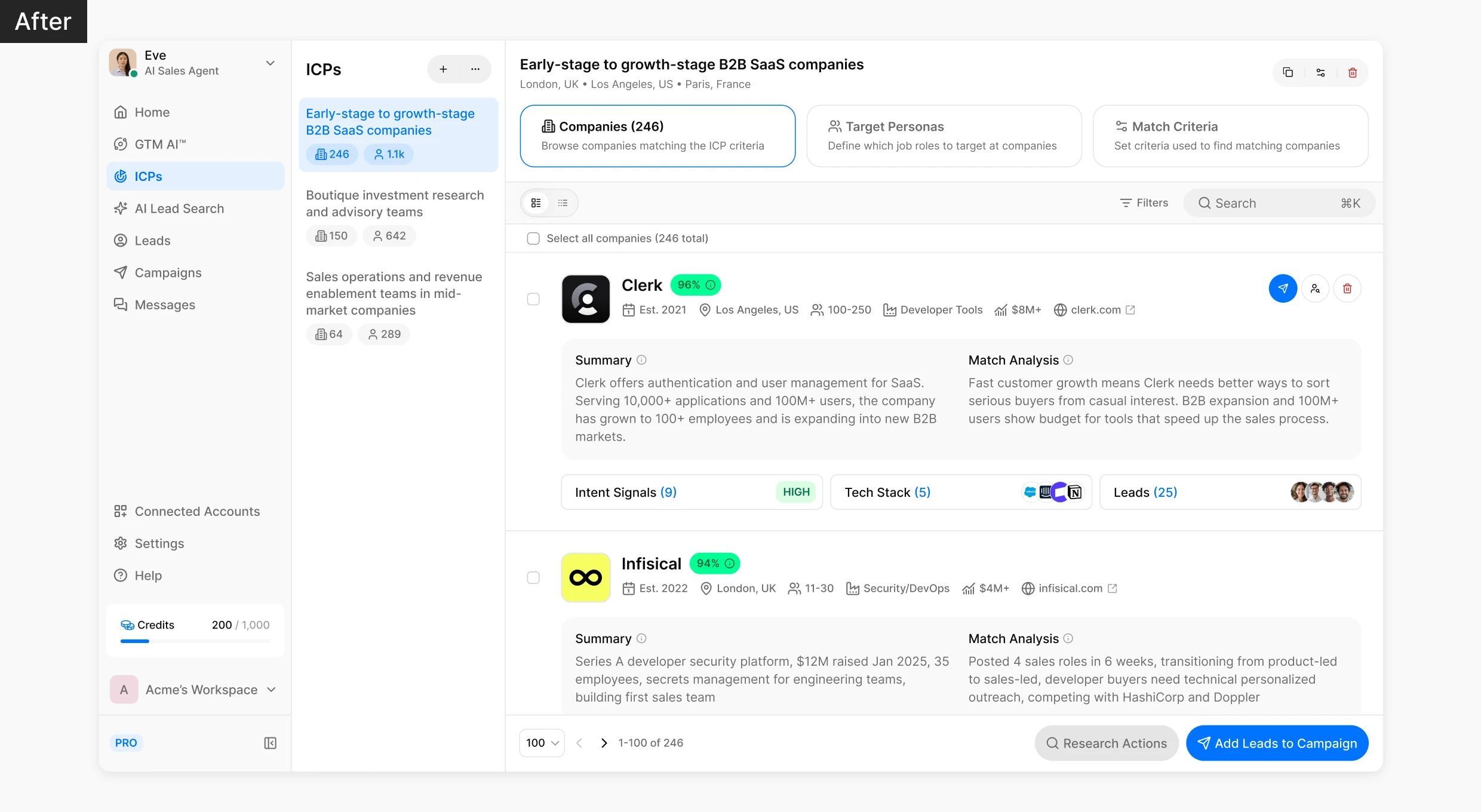
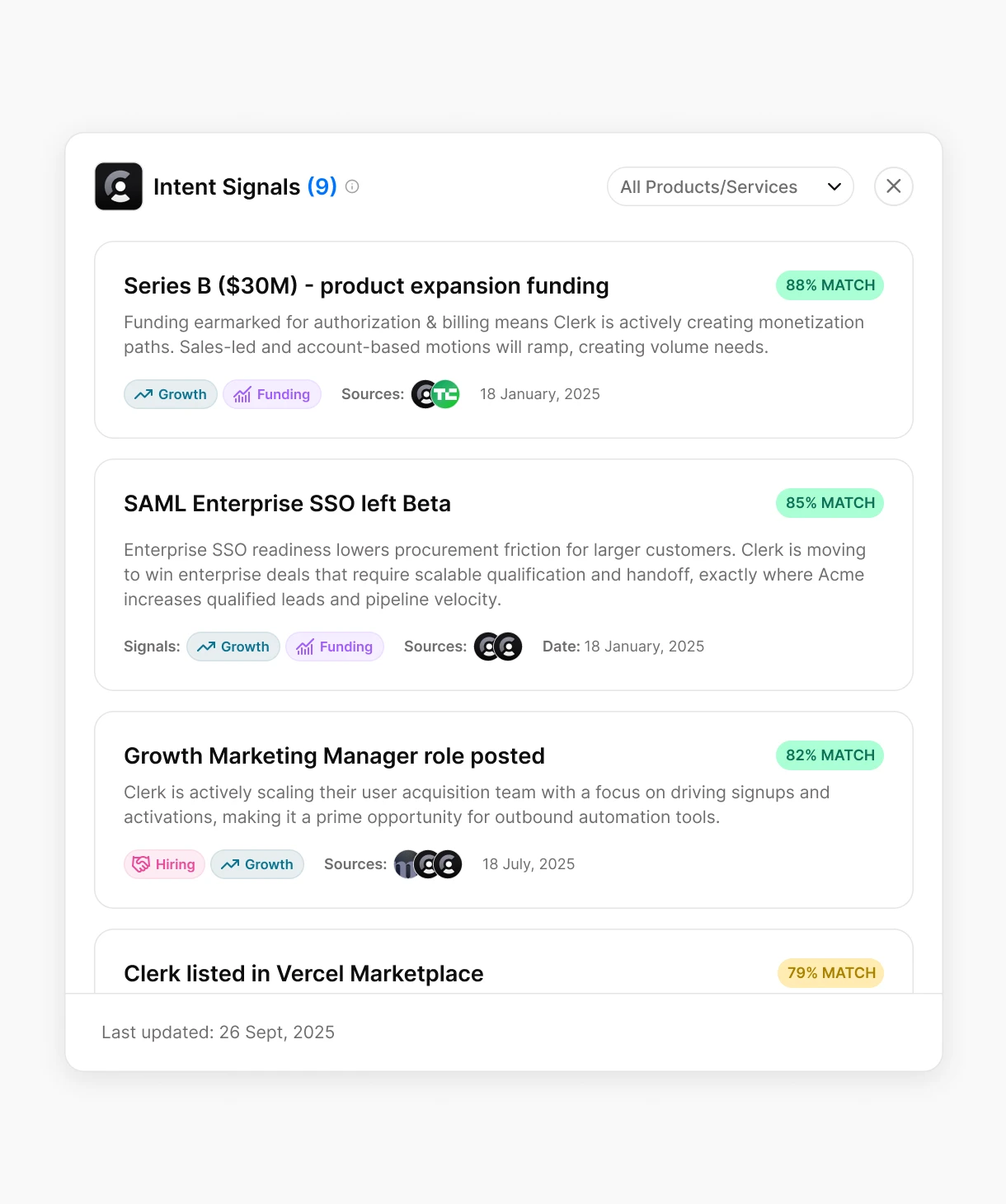
GTM AI performs deep research on the company and structures it into a profile that can be reviewed and confirmed. Website content, product pages, case studies, hiring signals and messaging are analysed, then translated into a go to market profile that describes what is being sold, who it is being sold to, and which problems it solves.
This change removed a large part of the cognitive load from users. Rather than inventing an ICP from scratch, users can validate one that has been inferred from their company positioning and evidence. Once the company profile is confirmed, GTM AI generates target ICPs, finds relevant companies within those segments, and surfaces decision makers aligned to the right personas.

Measuring success

With a redesigned flow, success was evaluated through a mix of product signals and feedback loops.
Campaign creation became a key metric. Creating a campaign is a commitment point, and it generally only happens once users feel confident in the company list and personas that have been generated. Alongside this, structured feedback was gathered from the original test users and from new users moving through onboarding for the first time, to compare clarity, confidence, and speed.
While broader business metrics are still evolving due to timing and external factors, the qualitative signal improved significantly and early retention patterns are encouraging. Users returned repeatedly, including daily usage in some accounts, and feedback shifted from distrust in lead quality to confidence in the platform direction and the value of company first targeting.

Scaling Cykel

Alongside work on individual agents, there was a strong focus on how the platform could scale. The aim was to ensure that each new agent increased the platform’s power without increasing perceived complexity for users.
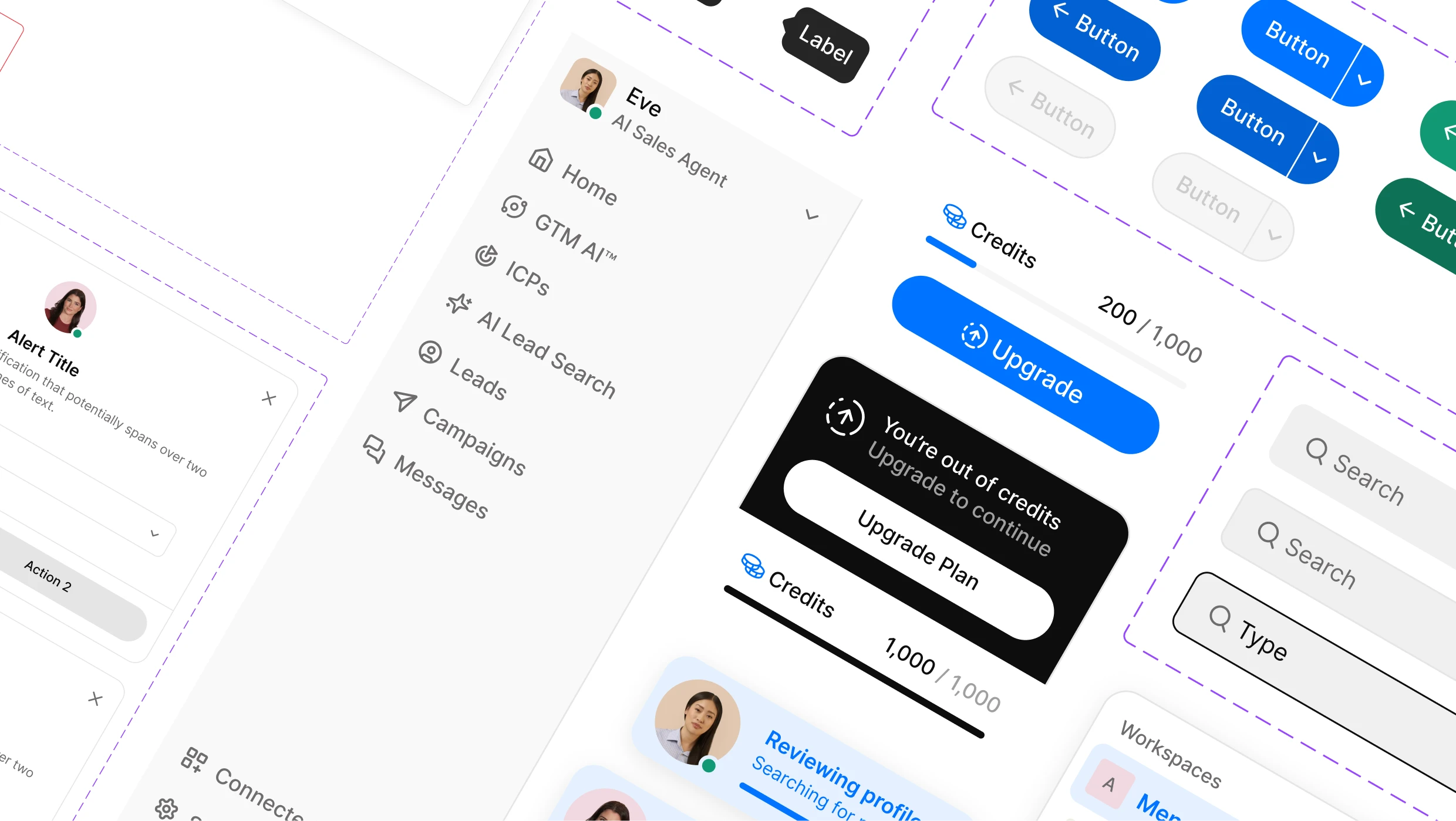
Information architecture and interaction patterns were designed in the UI3 design system so that multiple agents could coexist in a single coherent experience, with consistent ways of showing status, surfacing insights and asking for input. This creates a repeatable pattern for adding new agents without rebuilding mental models each time.
The roadmap continues to be guided by feedback from customers and internal teams, prioritising features that reduce friction, shorten time to value and have clear commercial impact. As a result, technical sophistication is growing steadily in the background while the surface experience remains focused, predictable and easy to navigate.